

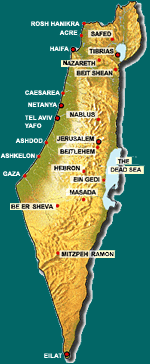
Please
click on map
for list of properties.
As befits a geographically small country undergoing rapid economic development, Israel boasts a very active real estate market. Construction and development in the market is dominated by the private sector, while the land market is dominated by the government. The real estate market in Israel has undergone and is continuing to undergo a significant process of maturation, moving from a market characterized by limited choice and options and low quality construction, to one which now boasts a wider range of alternatives in terms of location, size, building quality, and amenities.
The foreign investor seeking to purchase or lease a property in Israel for investment or for corporate use should familiarize himself with the operation of the market in Israel, in terms of pricing dynamics, location alternatives, the types of property available, and the legal and financial framework within which the Israeli market operates.
Location Alternatives
Commercial real estate in Israel is typically found in one of two types of locations, either center city "central business district" locations, or in outlying industrial areas which function much as suburban office parks. The two sources of property serve different purposes and markets.
Center city locations, such as those in Tel Aviv, Jerusalem, and Haifa, cater to financial and service businesses, professional services, media and government offices.
In addition, most retailing has historically been concentrated within the city and town centers, although the past decade has witnessed an increasingly dominant trend of construction of shopping centers and strip malls on the outskirts of the urban areas, adjacent to major highway and road development.
Industrial areas, located on the outskirts of Israel's cities and towns, house a mix of uses, primarily high technology, manufacturing, and warehousing tenants. These industrial areas have also been the site of much of the recent growth in retail development. In recent years, these areas have begun to take many of the characteristics of suburban office parks, albeit with a higher concentration of development as is typical in Israel. Computer, electronics, and other high technology firms, whether engaged in development or in actual manufacturing, generally seek locations in the industrial and suburban areas, with a preference for industrial areas where other similar companies are concentrated, or separate industrial or suburban office park developments.
This overall trend of office, industrial, and commercial development outside the urban centers coincides with the rising level of automobile ownership and subsequent increased mobility of the country's population and the trend of private home construction and suburbanization.
Development Areas
The majority of the country's land is held by the Israel Land Authority, which was created in 1960 to administer lands held by the state, primarily those which had been acquired over the years by the Jewish National Fund. In keeping with the nationalistic and socialistic concepts prevalent in the governments of the time, those lands were considered national lands, and were not to be sold permanently, but rather to be leased for a period of 49 years, with an option for renewal for an additional 49 years. The lease period corresponds with the biblical concept of the Jubilee year, in which all lands sold during the 49 year Jubilee cycle were to be returned to their original owners in the 50th year.
Minhal land is offered for lease in periodic closed bid auctions which are announced to the public in the newspapers. The land is initially leased under a development contract which requires construction on the property within a specified period of time, usually three years, after which the lessee receives an actual lease. The construction requirement is intended to encourage development, and to prevent speculative purchase of land, where an individual might seek to lease Minhal land in anticipation of a price rise and subsequent resale. In addition, the Minhal requires lessees to submit to it for approval all building plans on properties it leases, in addition to the normal approval process of local authorities. This contract provision adds more time, effort, and cost to the approval process.
Minhal land is leased without tender to specific end users only in special situations where the government seeks to encourage growth, such as development areas where land may be leased directly to industrial companies and developers for special uses.
The predominant form of Minhal land leases are capitalized land leases, where the major portion of the entire stream of payments for the 49 year lease period is prepaid at the outset, with the total price calculated to take into account the value of the up front payment. The most common type of lease is executed by an initial payment of 91% of the property value, with no additional payments. The remaining 9% is symbolically the state's portion of ownership.
The initial lease is for a 49 year period, with an option for an additional 49 years.
Although many buyers prefer private land, nevertheless, most investors have no choice but to purchase Minhal land. It is interesting to note that prices for private versus Minhal land do not vary greatly within the same property market.
When investigating the ownership and title of a piece of property the purchaser must first check the Tabu, as the land registry is commonly called. The word Tabu comes from the name of the land registry during the Ottoman Empire. There, upon payment of a fee and submission of a request listing the property's location, the registry provides a document listing the size of the property, its owners, and any mortgages, liens, or other restrictions on use or ownership.
If the property is Minhal, the Tabu registration will generally not list the name of the lessee, and the potential buyers must request the seller to provide copies of the contract with the Minhal, and to check the file at the Minhal itself to verify that all payments have been made, the existence of mortgages or other liens or payments to the Minhal, and that the property may be transferred. Today the Minhal is undergoing a process of registering land in the land registry as a means to centralize all land ownership information.
The title registration of many residential properties, particularly those which were constructed on Minhal land by one of the large public building companies such as Shikun Ovdim or Shikun U'Pituach, has remained at the offices of these companies, who function as land registries for subsequent resales of these apartments.
Title insurance is new to Israel and is currently only available for residential property. The Israeli real estate law sees registered title and not contracts or occupation as the only determination of ownership. Thus one must verify title and register title to protect ones possession of property.
The use of a property or its potential for a particular use, is determined by the city building plan, which defines the permitted uses of a specific site or area, and the size and bulk of a building which may be erected on the site, as well as additional requirements such as landscaping, parking or sewage hookups. These building plans are typically initiated by the local government and must also receive approval at regional and national levels. Various city as well as national and regional plans can be in effect simultaneously, each governing a
different aspect of the overall form of an area, with one for roads, another for building rights and permitted uses, a third for parks and public facilities, and so forth.
Land owners can also initiate new building plans or changes in existing plans, to enable new development on their properties or changes in use.
A potential purchaser of real estate must check the relevant plans governing the property he is considering in order to verify that it meets the relevant criteria, and to evaluate the potential or danger of changes in the future. Such changes can raise or lower the value and potential of a property. The city plans are generally available in the local municipality or building department, and consist of a map and set of regulations. Plans in preparation and under consideration are normally begun at the local level, and then publicized for public comment by the regional planning board. After all public comments are received and dealt with, the plan is finally approved by the Ministry of Interior. The process is lengthy, and can take several years.
Real Estate Economics
Leasing Property
Lease payments are generally linked to the Israeli rate of inflation, which is published on a monthly basis by the Central Bureau of Statistics. It is sometimes possible to negotiate a lease linked to the dollar exchange rate, or to the dollar plus the U.S. Consumer Price Index.
In addition to the rent, a tenant pays city taxes, building maintenance fees for care of the common areas, all utilities and VAT.
Most leases are executed for periods of up to ten years, the lease being divided into an initial period and option periods thereafter, which the tenant can exercise with advance notice. Rents are generally paid on a monthly or quarterly basis, and tenants are often required to post a guarantee in the form of a cash deposit or bank guarantee equivallent to 3-6 months rental obligation.
Most commercial leases of office space include landlord executed or subsidized tenant improvements. Most deals of this nature are for a minumum of five years as the landlord invests $250 - $350 per square meter for tenenat improvements. Property leased as a shell will rent for $3 - $4 per square meter less than finished space, but will require a significant investment by the tenant.
Purchasing Property
Many commercial properties are sold while under construction, and the purchaser pays for the acquisition in staged payments, according to the progress of construction, the final payments executed upon physical transfer of the property and formal registration of ownership. Buyers should receive a bank guarantee for all payments until receiving physical possession and registration in the land registry.
The apartment sales law requires all developers to provide special bank guarantee for payments received before delivery. This also applies to none residential deals. The cost of receiving this bank guarantee is usually born by the buyer in commercial deals, though the law obligates the contractor to provide the bank guarantee. The guarantee can cost up to 1% per annum against the value of each payment.
Tax Status - Categories
Real estate companies "igud mikarkein" - any company whose assets are real estate in Israel. This category can be avoided by holding one one non-israeli real estate asset.
Private individuals - persons owning one or many properties not as a company. Usually private individuals will hold residential properties, but will form a company to hold commercial properties due to the tax structure.
Taxes on Transactions
1. Purchase Tax: 5% for commercial properties and land, 0.5% - 5% for residential properties depending on if it is a single residence or a second residence. The second home tax rate also depends on the value of the purchase.
2. Sales tax: This tax was instituted 1/1/2000 instead of the property tax on land, which was cancelled. When purchasing land one must verify that back property tax was paid by the owner.
The sales tax is on built property and land except for a single private residence buyer which is exempt. Real estate companies and private individuals that hold the property as a fixed asset pay 2.5% of the deal value. Developers and constractors that sell stock pay 0.8% of the deal value.
3. Real Estate Capital Gains Tax: This tax is paid by real estate companies and private individuals upon the sale of property or when land in exappropriated with compensation. The tax is based on the increased value of the property from the date of purchase. The calculation of this tax is complex due to inflationary monetary values and special allowances for historically owned properties. One must note that the "value of the property" is not always the contract sale price.
4. Income Tax: Contractors and developers that sell real estate stock pay income tax instead of capital gains tax on the sale of property.
Income tax on rental income is partially exempt on residential properties, but income from commercial properties is taxed at the owner's personal or corporate tax rate.
Other Real Estate Taxes
2. Temporary Improvement Levy: This is used when a property receives temporary zoning for an upgraded use, where there is no permanent zoning for this use. For example the use of offices in an industrial area could require the payment of this tax. It is charged at the same rate as the improvement tax, but allows for upgraded use for 5-10 years.
3. Municipal Taxes: These taxes are paid by the end-user and not the owner. Vacant property has a one time six months exemption from municipal taxes. End users pay rates according to the use: offices, banks, technology, restaurants, private families, etc.
Commercial property financing is usually at a Debt/Equity ratio of 70/30 to 80/20. The banks are limited in total lending for income producing properties, and thus try to lower the D/E ratio on such deals or alternatively raise interest rates. Bank of Israel regulations limit the ability to leverage properties for further acquisitions.
Shekel-Fixed Rate or Fluctuating Rate: since most income on property is in shekels and linked to the inflation index it is recommended to borrow in shekels. Shekel loans are generally indexed to inflation.
Foreign Currency Linked: these mortgages can only be set up to 7-10 years. Banks tend not to fix foreign currency interest rates beyond this period.
All mortgages require a registered lien in the land registry and often personal guarantees of the signators. Non recourse financing can sometimes be negotiated.
In Israel it is customary for a broker to represent both sides of a transaction, both buyer and seller, or owner and tenant. Commissions paid by each side, are 2% of the price plus VAT for purchase of property, and a fee equal to one month's rent plus VAT in the case of rentals. Both are one-time fees.
Lawyers: In executing commercial transactions, it is customary for each side to be represented by an attorney. Normally the owner's attorney prepares the contract document.
Real Estate Appraisers: in determing the value of the transaction to the buyer or the buyers bank, it is necessary to hire a professional appraiser. Appraisers are also required in assessing and negotiating improvement taxes and other land taxes.
We realize
that you may have other questions. Please do not hesitate to contact
us.
A practical starting point for understanding the Israeli market is from the perspective of the various location and site alternatives which the market presents to the investor and user.
As part of the government's ongoing efforts to encourage industrial development, particulary in small towns outside of the center of the country, the Ministry of Trade and Industry administers development grants and tax incentives for creation of industry in these areas. In addition, companies seeking land in these areas may apply and receive site allocations at subsidized prices for construction of factories.

Land Ownership
In Israel, there are two types of land available. Property may be built upon:
Identifying and Registering Property Title
Formal identification of properties in Israel is by the block and lot system, where a large area -the "block"- is defined, numbered, and then split up into smaller pieces, the "lots". The actual size of a block and its individual lots can change dramatically from area to area, depending usually upon the actual amount of development in the area. As the density of development increases, the number of blocks and lots increases and their size decreases.
Land: Use/Zoning/Building Rights
Land is measured by the "dunam" or 1,000 square meters. The size of zoned land is quoted in net dunam. When purchasing unzoned land it will usually be quoted in gross dunam. The buyer must verify how much land will remain after expropriation for public use, such as roads, public facilities, etc.
Prices in the Israeli real estate market are delineated in dollar terms, a convention which the market has adopted due to the fluctuations of the shekel, thus providing a steady frame of reference when comparing offers, and negotiating. Once contracts are signed transactions are converted to the shekel amount and linked to the Israeli inflation index. Prices are quoted per rentable square meter, called "gross space". The rentable meter is measured from the outside wall, and includes the relative portion of the building's common area and service core (lobby, elevators, stairwell, machinery rooms, etc.). The difference between gross and net space ranges from 10 - 15% in light industrial properties, to 25 - 35% in fully serviced office towers.
In the case of properties being offered for lease, prices are quoted in terms of dollars per meter per month, for example, a 200 meter office in downtown Tel Aviv might rent for $20 per meter, or $4,000 per month.
Real estate has historically been one of the best avenues of investment in Israel, due to the country's rapid rate of growth and relative scarcity of available product. Investors have profited from steady increases in value, and from returns from rentals, which as of this writing, range from 8-10% per year on commercial properties.
Taxes
Israeli real estate taxation is very complex. Proper tax planning in each transaction can prevent costly errors, and provide the optimal terms for the future resale of the property.
Contractors and Developers - hold land as stock and not as a fixed assets.
The following represent the taxes for the execution of all real estate transactions
1. Improvement Tax: This tax is paid upon a zoning improvement increased building rights or higher level use. This tax is equal to 50% of the increase in value after the upgrade. Very often the level of this tax can be disputed with the aide of real estate appraisers.
Financing Loans
There is little competition between commercial and mortgage banks in real estate financing. New players to the market of real estate finance are insurance companies and pension funds.
Professional Advice
Real Estate Brokers: in renting or purchasing a property in Israel, many buyers utilize the services of real estate brokers. Brokers in Israel are licensed by the state, and many are members of the professional organization MALDAN.
Contact Us | Home